Design Statement
What is Proxima A?
The most common question that I get asked when introducing someone to one of my amplifiers is "what is it based
on?" It's an understandable question. The boutique amplifier space is filled with models that are copies or
incremental updates of amplifiers produced in the golden age of tube guitar amplifiers—so much so that it must
seem that every boutique amplifier is based on a Fender, a Marshall, or a Vox. It would certainly be much
easier to explain what the amp is if it was based on some other well known model—you could convey with a few
words what one should generally expect and someone can come away from a brief description able to imagine more
or less what that amp must be like.
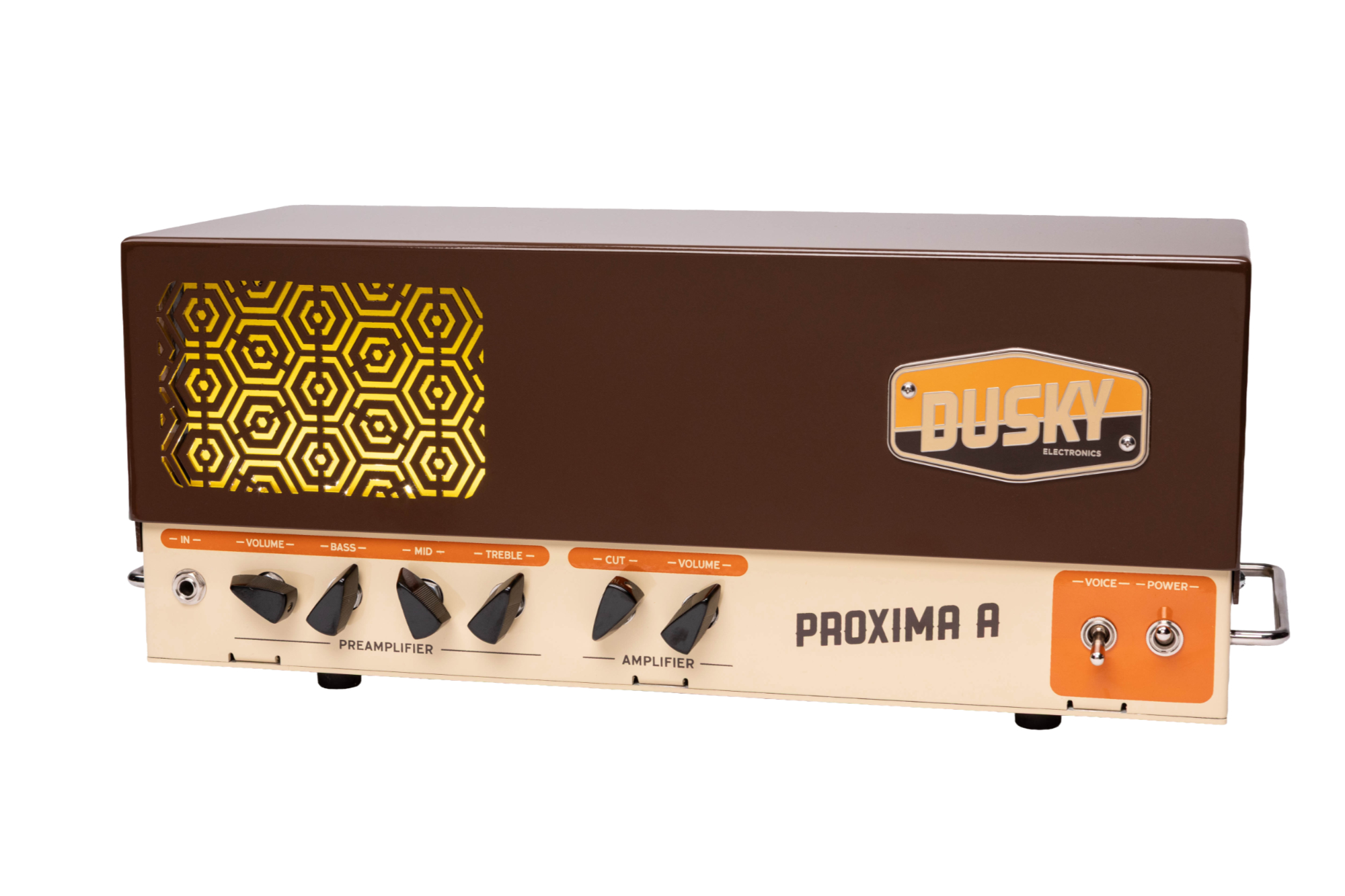
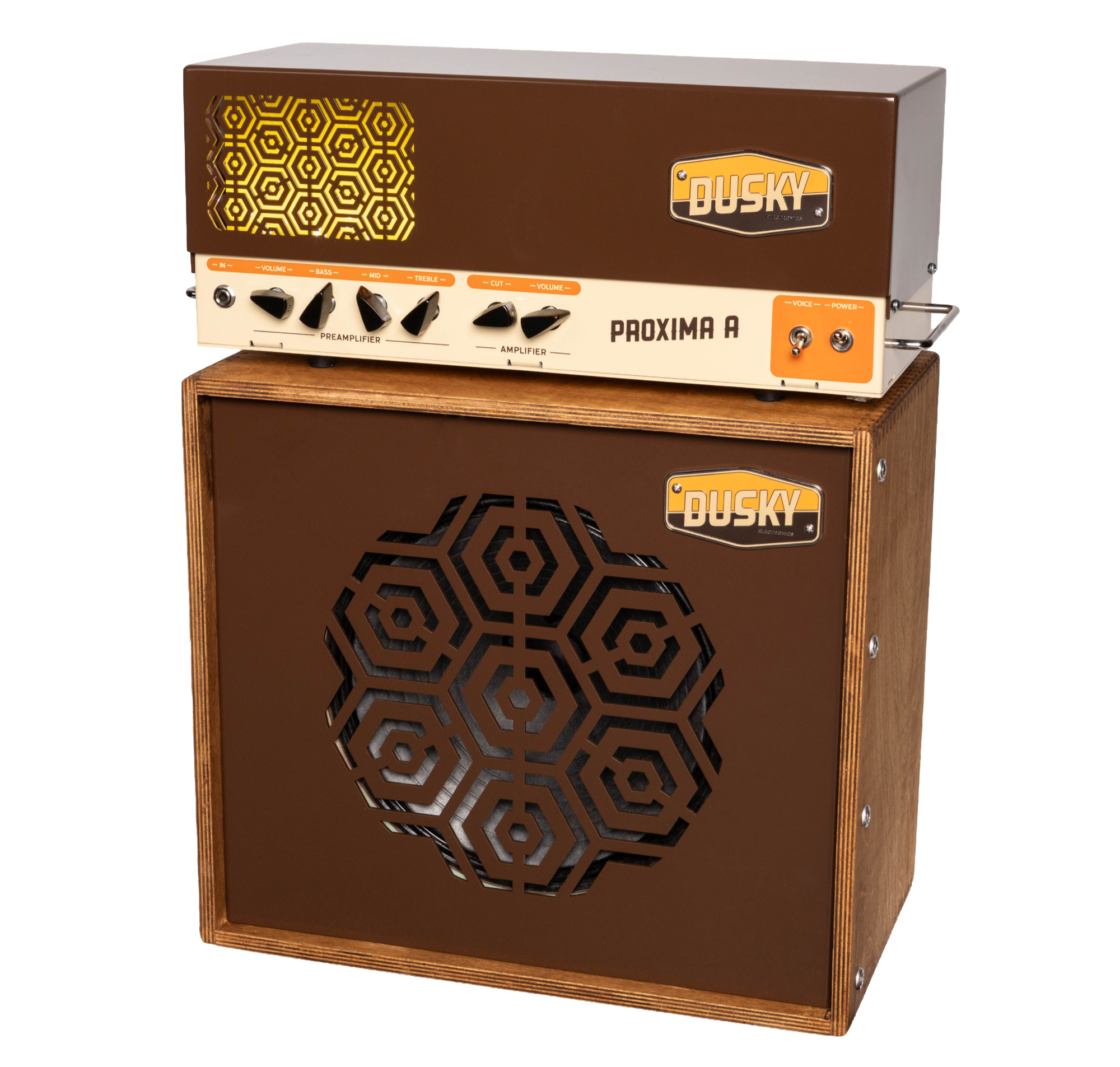
In the case of the Proxima A, I can say that it is based on and is an update of the Dusky D₂O Amplifier. Sadly,
as I am the designer of that amp as well, all I've done is kick the can down the road back to myself. The D₂O
is an original design and is not based on any particular antecedent.
Maybe it would be best to let someone who hasn't designed the amp tell me what they think it is. In the end,
what counts is the player's experience, so why not just let a player describe it? I've run this experiment
informally many times now and the results are interesting:
Every player I've ever shown one of these amps to has given me a thoroughly different description of it. The
differences aren't subtle either—it seems they are describing completely different amplifiers. For one
player, it is a beautiful clean amp, with a sound that is weighty, complex, and clear. For another player it is
a balls to the wall rock'n'roll overdrive machine. In the end, as far as I can tell, players aren't telling me
about the amp, they're telling me about themselves as players and what they look for in an amp. And somehow,
despite every player looking for something a little different, most of them seem to find whatever that is in my
amps.
So maybe the best description of these amps is they are mirrors. These amps reflect and bring out
whatever it is about you that makes you you and not some other person.
I know, that's still pretty vague.
Design Process
As an engineer, the main way I know how to describe Proxima A is from the engineering and design perspective.
I'll walk you through the electronic design and try to describe the subjective and artistic considerations
behind the choices made in the design.
D₂O Amplifier
It all starts with an idea, and the idea I wanted to try out when I first started designing the amp that would
become the D₂O and the Proxima series had to do with the EQ controls. I had done some reading about the James
tone stack which is a circuit that features independent, non-interactive bass and treble controls that unlike
more standard FMV (Fender, Marshall, Vox) tone stacks, can be set to have a flat frequency response. I had an
idea that I could marry that to a twin-T filter for control over midrange and get a much more flexible set
of controls than what you typically see on a guitar amp. In the design phase it became pretty clear that the
James tonestack, which would provide the BASS and TREBLE controls, would need to be electronically isolated
from the twin-T filter that would provide the MID control, or else they'd throw each other off. I wound up
situating the VOLUME, BASS, and TREBLE controls after the first tube gain stage and the MID control after the
second gain stage to make that work.
I also wanted to play with octal preamp tubes, really mostly out of curiosity. Would they sound cool? It turns
out, yes they would. The 6SL7 was the most common high mu triode in that family of tubes, ie the closest analog
to the 12AX7 most tube amp aficionados are familiar with, so I decided to use those. They are still in
production, so wouldn't require having to source NOS (New Old Stock) tubes. Even though the 6SL7 and 12AX7 work
the same way and do the same basic job, they do sound and feel a little different. The 12AX7, to me, sounds a
little more brash and aggressive, while the 6SL7, to me, sounds rounder and smoother. Cleans sound big and
overdriven sounds are really nice.
For the phase inverter, I decided I wanted to play with a paraphase phase inverter. To make a long story short,
it's a relatively primitive circuit that can have better overdrive characteristics than other "better" designs
by virtue of it being a pair of ordinary triode gain stages which overdrive in a fairly natural, pleasing way.
At this point in the design phase, I could draw a schematic that described an amp that I was pretty sure would
pass a signal, but until I built it, I would have no idea what it actually sounded like. This is where my
patent pending "fuck with it until it sounds good" methodology really came into its own. After building the
amplifier for the first time, I could play it, listen intently, and then decide what tweaks I should make. This
is ultimately a very interactive process where the amp that wants to be is gradually revealed to me over weeks
of tweaking and listening. I think for the D₂O, this phase took about six months. I started to feel that I must
be done when I would forget about the amp and just play—when it started to feel like a natural extension of
myself.
There were some options in the original design that wound up getting scrapped because after trying them out I
didn't find they really added anything. But one control did get added during this phase: the CUT control. When
really cranking the amp to get it to distort, I found that with some speakers the high frequencies could start
to build up and get really harsh, so I borrowed a Vox style CUT control from their AC30 amp. This is a passive
roll off of high frequencies that happens in the power amp section to optionally tame some of the harshness in
the high frequencies.
There were some criteria that were important to me. The bass had to be able to hold up without getting flabby.
This was largely accomplished by using over-specced iron core transformers and stiff filtering in the power
supply. The cleans had to be gorgeous and the amp had to sound great as a clean pedal platform. The breakup
also had to sound good and exciting without necessarily sounding like any other specific amp. The amp needed
to be as hum and noise free as I could get it. Over time as I tweaked, I eventually realized all my goals with
the amp and had built something that I really, really enjoyed playing.
Proxima A
By the time I got around to designing the Proxima A, I was building on the platform I'd established with the
D₂O and layering in some feedback I'd gotten from players and some features I wanted for myself. I had been
asked at one point if I could make something smaller. Another player had told me how she had had to use an
overdrive pedal with it because it didn't have a master volume, so she couldn't turn down the volume while
turning up the gain.
These requests ended up dovetailing nicely with my own desires. I've always loved 6V6 power tubes, having used
a Fender Deluxe Reverb as my primary amp for a good decade or so before designing the D₂O and switching to
that. I was also interested in something a little lighter weight, both physically, and in terms of output
power. While I had, for years, thought of the D₂O primarily as a clean pedal platform amp, I had grown more
interested in exploring the crunchier/gainier textures of the amp itself and was interested in where I could
take that platform.
I started designing the Proxima A by experimenting with my personal D₂O, first developing a buffered post-phase
inverter master volume that just turned down the volume right before hitting the power tubes without changing
the frequency response at all. The D₂O did have a switch in the back to put it into a lower power, 8 watt mode,
but now instead of two options for output level, I had a continuously variable control that could sweep
between silent and full power. This one change impacted user behavior a great deal and made the amp instantly
feel gainier, since now you could turn up the gain in the preamp and set the output volume independently. To
buffer the master volume, I turned to the LND150 transistor, a high voltage depletion mode MOSFET. This
transistor can handle up to 500V and works exactly like a tube, so it was an easy choice as it could use the
same power supply as the tubes, was tiny, and could do its job without imparting any flavor of its own.
Not satisfied with just adding a master volume, though, I wanted to explore gain even more, so I started
developing a boost stage that could be switched in at the input to the amp to drive the tubes harder and get
more tube crunch. I decided to try the LND150 out in this role as well and I liked the results so much that I
kept it. Most of the work with designing this piece was experimenting with just how much gain to add and what
frequency sculpting to do to complement the gain. I wound up with two voices: one with a moderate amount of
gain and minimal frequency sculpting, and one with a good bit more gain and a pronounced high end roll off to
tame the extra harsh harmonics added by the distortion.
With those two pieces designed, the next thing to do was to build a new amp with these tweaks married to a new
6V6 power section. Since most of the R&D had already been done before ever assembling the first Proxima A, it
ended up coming together pretty quickly and being mostly ready to rock, with just a minor tweak here and there.
As the D₂O had become when I first designed it, Proxima A has become my primary amp. It feels like an extension
of myself and I don't feel there's anything I'd want to do with it that I can't.